
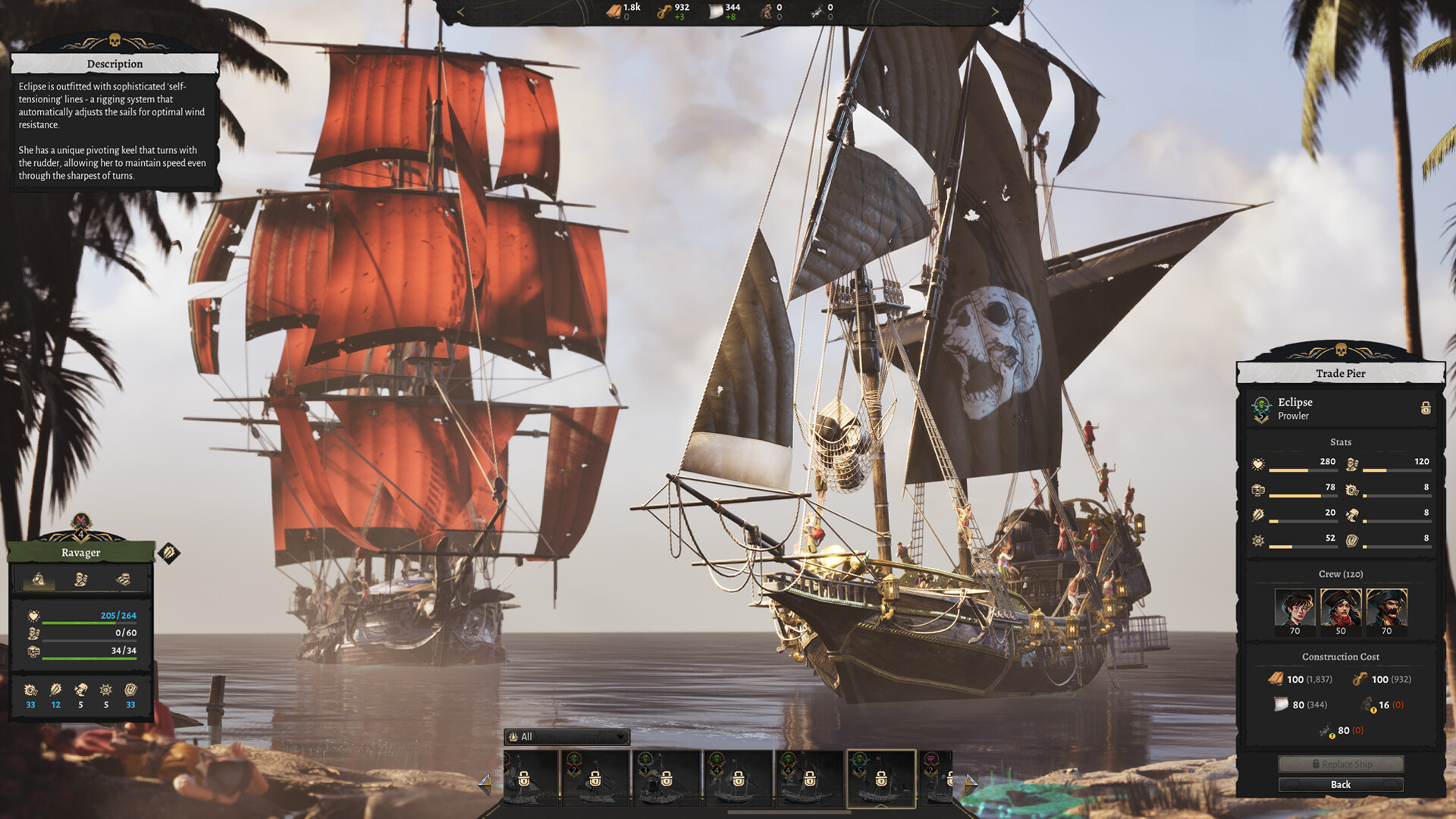
Corsair Cove confirms an economy in which more than fifty types of goods are manufactured and distributed. Raw materials move into production, finished goods leave it, bridges and ziplines help goods cross the settlement’s height, and distribution hubs receive finished products. Those statements are enough to build a useful diagnostic ledger even though the supplied evidence does not contain a complete recipe database.
Use this page to identify the stage where a flow has broken. It deliberately avoids assigning every resource to a recipe, placing production stages on fixed cliff levels, or publishing throughput values without a trusted in-game source. The goal is to help the player ask the next correct question and then move to Resources, Buildings, or the Walkthrough for a focused answer.
- Scale
- More than 50 goods
- Flow
- Raw materials to finished goods
- Movement
- Bridges and ziplines
- Destination
- Distribution hubs
Inputs
Begin with a named material or good. The confirmed resource ledger includes iron, copper, lumber, fiber, grain, coin, whale blubber, silver, and wine. These names establish a varied economy, but they do not prove that each item is a raw input, a local product, an import, or part of the same chain. The Resources page therefore presents them as a verified name index before any deeper categorization.
For diagnosis, write down the exact item shown in the interface and the place where the shortage becomes visible. Then trace backward toward its source or forward toward the building that needs it. This separates the observed item from assumptions about where it should come from. If the route crosses height, inspect the connection before changing unrelated production areas.
An input checkpoint is complete when the item name is known, the relevant route can be followed, and the next processing area is identifiable. If one of those facts is missing, pause there. Expanding the settlement before the input side is readable can hide the original break beneath more buildings and longer paths.
Processing
Processing is the middle of the confirmed flow: raw materials become finished goods, and more than fifty types of goods are manufactured and distributed across the game. The handoff does not include a recipe list, cycle times, worker counts, or production ratios. A responsible wiki should not turn the phrase “more than fifty” into fabricated tables merely to resemble a mature database.
Use named buildings as anchors where the official evidence supports them. Cannon foundries are the clearest industrial example, while the broader catalog also names living quarters, taverns, piers, defensive fortifications, and the Entertainers’ Guildhall. The building page explains what is confirmed about those names and keeps unsupported outputs out of the table.
A processing checkpoint asks whether the needed input reaches the relevant area and whether the resulting finished good has a continuing route. If materials arrive but the output does not progress, the next investigation moves toward distribution. If materials never arrive, return to inputs and vertical movement. This two-direction trace is more reliable than changing several buildings at once.
Movement across height
Buildings must connect across cliffs, and bridges and ziplines help move goods across height. That makes movement a full stage of the economic model rather than a decorative note between production and distribution. The official evidence supports the existence of vertical connections, but it does not support a universal claim that all inputs begin at the shoreline, all processing sits on a middle tier, or all distribution belongs on the summit.
Inspect movement as a route with endpoints. Identify the material or finished good, the area it leaves, the bridge or zipline segment that crosses height, and the area it must reach next. The highlighted bridge placement shown in the walkthrough is useful visual evidence for this problem, but no screenshot proves a single optimal layout.
A movement checkpoint is complete when the route is continuous and the economic stages on both sides are known. If a path exists visually but the flow is still unclear, return to the named input and destination rather than assuming the connection works exactly as it appears. The production ledger is a reading method, not a substitute for the live interface.

Distribution
Distribution hubs receive finished products. This is the supported destination statement that completes the chain from inputs through processing and movement. The handoff does not specify hub capacity, coverage radius, staffing, or demand calculations, so the page stays focused on the observable handoff: finished goods should continue from production toward a distribution hub.
When a finished good appears to stop, trace the last confirmed processing point and every vertical connection between it and distribution. Check whether the issue is the product itself, the route across height, or the destination. The home resource table links goods back to the pages most likely to answer those questions, while the walkthrough places distribution after pathing and production in the first-haven sequence.
A distribution checkpoint is complete when the finished product, route, and receiving hub can all be identified. That does not guarantee ideal performance, but it gives the player a clean baseline from which future verified values—capacity, timing, or demand—could be added without changing the site’s information architecture.
| Stage | Confirmed statement | Do not infer |
|---|---|---|
| Inputs | Named materials and goods exist. | A complete recipe or source classification. |
| Processing | More than 50 goods are manufactured and distributed. | Ratios, cycle times, or universal layouts. |
| Movement | Bridges and ziplines move goods across height. | A fixed cliff level for every stage. |
| Distribution | Hubs receive finished products. | Capacity, radius, or demand formulas. |
Frequently asked questions
How many goods are in Corsair Cove?
Official store descriptions state that more than fifty types of goods are manufactured and distributed. The supplied research does not contain a complete verified item-and-recipe database, so this page preserves the confirmed scale and flow while avoiding invented names, ratios, cycle times, or production formulas.
Do production stages belong on fixed cliff levels?
The evidence confirms that buildings connect across cliffs and that bridges and ziplines help move goods across height. It does not establish a universal shoreline, middle-cliff, and high-cliff placement for inputs, processing, and distribution. The ledger therefore shows sequence without assigning unsupported spatial rules.
What receives finished products?
Distribution hubs receive finished products. When a flow stops, trace the finished good from its processing point through every vertical connection toward the receiving hub. The current evidence does not provide hub capacities, coverage radii, or demand formulas, so those values are not estimated here.
Sources
- Corsair Cove on SteamFirst-party source
- Corsair Cove · Epic Games StoreFirst-party source